You’re not terrible.

Tonight during our interminable bedtime ritual, the rollercoaster of “I love you…when will this nonsense end…I love you…I can’t take this one more stinking minute…I love you…good god what is it now,” Spouse did something silly. And Three found it horrible. And I told the little guy, to stave off the raging insanity that is a three-year-old Butter freakfest, that Daddy was only trying to be silly, and that it didn’t turn out the way he’d hoped.

And somehow in there, I said, in my best silly voice, “because Daddy is Terrible.”

Immediately, Seven said in just the right voice, “He’s not terrible.” And my sweet Peanut wrapped his arms around my neck and sat in my lap and whispered, “He’s not terrible and you’re not terrible. Everyone makes mistakes. You make mistakes. He makes mistakes. Everyone alive makes at least one mistake in their life. Probably more.”

And I kissed his head and told him he was right and brilliant.

And I waited until later to cry.

Because what I’ve waited for, in my pathetic, childish, needy way, has been for my children to show me the kindness I never show myself. To hear a thank you, to be told to ease up a bit. To be told I’m not as terrible as I think I am.

And my almost-second-grader whispered kindly in my ear that I should cut myself and my husband some slack.

I’m not an expert at anything. But I’m pretty sure that’s as close to perfection as life gets.

Equality

Last week over breakfast, our foreign exchange student announced that, on BART, she saw her first gay person.

I snickered a bit privately, since she’s seen way, way, way more than that. But I wanted to hear her story.

She said that, in her country, being gay is bad. That two women kissing on the train is not okay.

I braced myself for what came next and held my breath because the kids were listening. We have a friend who is transgendered and my children think such humans are just another kind of friend to have. In fact, the youngest doesn’t know and assumes, as he should, that our friend is a man because he’s a man. Of course, Butter’s three and thinks most of the trucks on Bob the Builder are female. So he’s clearly not attuned to conventional gender clues yet. But I didn’t know for the first few months of my friendship, either, and learned about Adam’s apples the interesting way.

We haven’t talked to our kids about what it means to be gay or lesbian, in part because gender is something children notice early, but discussing homosexuality involves ideas about attraction and marriage and being more than friends, which are by nature more mature than my children are. They know every family is different, and that some families have kids but some don’t; some have two adults in the family, some don’t; and that the families with two parents might consist of a man and a woman, a man and a man, or a woman and a woman. They know that we really like that different types of people bring different ideas and the more ideas you hear, the better you can choose what you believe.

So when Rosí announced that in her country bring gay is bad, I was prepared to stop her so we could continue later. Her opinions and experiences are valid, but they’re not always appropriate for small children.

“Yes,” she continued. “In my country this is very bad. But I think killing is bad. This? Kiss? Do you say ‘kiss’ in this way? [Yes, but you can say ‘kissing’, too.] This is love, right? And love is good. So I don’t like what they do, and I don’t think it’s right. But it’s not wrong.”

I have to say, I was impressed. I asked my eldest if he understood what we were talking about.

“Do you know the word ‘gay’?” I asked. “You know the families we know with two dads or two moms? The word for having a partner who is the same gender as you is ‘gay’.”

He nodded. “I know.”

“So she’s saying that, in her country, people believe wanting to be a family with someone who’s the same is bad. But she thinks hurting is bad, and that loving is good. What do you think?”

“Well, yeah,” he said. “Kissing is only bad if the other person says ‘stop’.”

Well, damn, readers. He just covered equality and respect in one answer.

These are good, open-minded kids I have. The two I raised and the one who just arrived three weeks ago. May they always kiss people who say “yes.”

[I haven’t talked with our guest yet about the Supreme Court decisions of last week. But when the boys and I heard on the radio, on the way to school, that the justices said the federal government can’t invalidate a legal marriage by withholding spousal benefits, and that the people in California who don’t like gay marriage have no legal standing on which to contest it, I sobbed as I explained to my children how important it is for a country to say that all people are legally the same. Of course we’re not the same. But legally, all people have the same rights. I told them how important it is to know that not liking something is not the same as being hurt by it. And that not understanding something is a reason to find out more, not to pass laws. It’s never too early to train the next generation of legislators, executives, and justices.]

Oh, no. You did not.

One pound of sugar a week.

Eight ounces of salt a week.

Five hours of Skype a day.

Three exclamations pronouncing American weirdness each day.

All of these I take in stride from our new housemate. Even though those numbers only represent the few hours she’s here at home. Heaven knows how much sugar and salt her employer is having to buy this summer.

But when our adopted friend from the Dominican Republic found the best parts of Say Anything outrageously funny, I had to draw the line.

Some cultural differences are simply unacceptable.

Now I refuse to show her Office Space. I don’t think she deserves it.

Instead I’m letting her watch The Wedding Planner. It’s the closest thing to torture I think I.C.E. will allow in our situation.

My baby again


Some parenting moments are bliss. Some include intense pain. Most are drudgery and frustration tinted with laughter. There’s sometimes just the teeniest bit of yelling. Occasionally.

But some moments make you stop.

I didn’t see my son fall and break his arm. I didn’t get a terrifying phone call. I just picked him up from school and talked with him about the best and worst of the day just like we did any other day. The seventeenth or eighteenth thing he told me on the walk home was that his arm hurt.

Easy, as broken arms go. And so we didn’t handle any of it like a trauma. Time didn’t stop. The day didn’t really seem different (except the long wait for an x-ray), the school year finished without further incident, and summer began pretty much as usual.

But today the cast came off. And my eldest baby’s tiny little arm emerged from the green fiberglass weak and vulnerable. He said the air hurt and he was scared to touch anything. So I tried to hold his hand. But that hurt, he said. So I kept a respectable distance even though it killed me.

We were escorted toward the examining room, but he seemed hesitant. So I told the nurse we were going to wash his arm before we saw the doctor. We slipped into the orthopedic department’s bathroom.

I have not, since my boys were babies, been so careful with the water temperature as I was with this peeling, pasty, dirt-bracketed arm. And not since he was brand new have I so gently washed him. I wanted to scrub off three weeks’ of unshed skin cells, rub off the grime that had accumulated around his little thumb.

Instead, I carefully removed his elementary-school filth and restored, for one moment, a time in which he completely trusted me. Without making him feel scrubbed. Or small. I got to remember how much time dissolves into genuine care. And he got pure nurturing without feeling little.

Today’s arm-rebirth was sweeter than the quiet Scrabble sessions we have while his brother is at preschool. It was calmer than his lethargic fever days when he sleeps fitfully until he rests on my shoulder and is then out for hours cuddled against me.

Today time stopped so at least one limb of my seven-year-old could be a newborn again.

But this time we already knew and understood each other, so the moment seemed even more sweet and tender.

Maybe because I know now that we might not have more episodes of naked vulnerability.

With a newborn, you expect them to need you for a while.

Seven years later, I’m not sure if I’ll get any more moments like this.

IMAG3475-1


Issues little and big

Week Two with a foreign exchange student was challenging. We’re settling into patterns, some good and some not so good. Our new friend is still excited to be here and is still marveling at things we take for granted, such as cars stopping at stop signs.

I’m still marveling at Spouse’s willingness to let me walk smack into a situation that does not suit me at all. I know full well that I’m dumb enough kind enough to offer our home to a stranger based on the recommendation of a good friend and the reassurance that it would be an amazing opportunity. But you’d think he would have, perhaps, guided me another way.

Well we have ourselves an opportunity and a half, right here in our house all summer.

And we only get out of it what we put in. So after reminding our guest for the fourth or fifth time that she really, really has to lock the doors, especially when she leaves the house, after giving in and letting her have all the white-bread-and-ketchup sandwiches she wants, and after deciding not to tell her about water conservation and drought in California, we found an evening on which to really connect.

As usual, I made a relatively plain meal. Well-seasoned lentils, israeli couscous with feta and olives, watermelon, and raw bell pepper. And she found it horrible, even after adding what I think might have been a quarter cup of salt. She went to her room to try on one after another of her outfits and to ask if they looked okay. In the lull after the nightly fashion show I read a blog post from my friend about how cancer is eating away his perspective and how he’s fighting to be present with his family.

So when Rosí came into the kitchen, instead of working, as I needed to, I joined her. And told her I have a friend who’s fighting cancer and has been for three years. She, in turn, told me about her grandfather, whose prostate cancer was misdiagnosed repeatedly even as her mother kept saying, “This is not right. Get another doctor.” The grandfather died two years later. We talked about cancer and about death. About how there are quite a few bad ways to go. She talked about HIV and the relative who died from complications from HIV-related conditions.

I mentioned that there was some hope with HIV as treatments are improving.

“Not in my country.” She told me that in the Dominican Republic the treatments were making almost no difference because successful HIV treatment requires, as she said, “paying attention and being willing to care about health.” That, she said, was not the way in her country.

She talked of the high cost of HIV medications. And of most life-saving medications. She talked of pervasive alcoholism in the DR. [World Health Organization stats suggest that her perspective is skewed by her town.] She said that in her neighborhood, many children walked the streets without shoes, without school, and without enough food because their parents drank what little money they had.

“So does it seem hopeless,” I asked, “with, as you say, many people using alcohol, and many people taking advantage of honest people by stealing and cheating?”

“No. You can never lose hope. My mother does not have a lot,” she said. “But she always made sure we have food and we go to school. No money for clothes? Maybe. But money for food. And she does it honestly. She doesn’t have a formal job but she does everything she can to earn money honestly. If we’re sick? Go to school. Not if we’re really ill, of course. But if we don’t feel well? Too bad. Go to school.”

“She knows what’s important.”

“Yes.”

I asked if it was hard to be honest and struggle when some give up and either drink or steal. It seems that is the struggle in many of the poorest parts of our country, as well.

“There is no choice,” she said. “There is no excuse for being dishonest. There is no reason. If you try hard, there is enough for food and school. Not for extras. But for food and school.”

As expected, I felt terrible about how we spend our money. I tell the kids we use money for food and shelter and heat and school and not for extras, but they have enough toys to say otherwise. And we have treats and new books and expensive coffee. I knew that guilt would come during our summer as American hosts.

But Rosí’s reminder about what’s really important brought me out of my deep sadness about my friend. People everywhere are struggling. Really struggling. He’s fighting with everything he has to make sure his family is loved. Rosí’s mom is sacrificing to ensure that her children have the necessities. They’re doing…we’re all doing…what it really takes to be good people.

Make sure kids are fed and educated. And loved.
Make sure family and friends know they’re important.
Lead by example an honest, hard-working, and purpose-filled life.
And give to others everything you can.

Well, then.

Take that, summer inconvenience.


Things get real in the second week.

My children are testing my superpowers this week.

My three-year-old wants to start ballet and baseball. On an all girls’ baseball not softball team, he says. And when does he get to be a girl, he asks.

“When do you think?” I counter. Bad for improv, good for parenting.

“Next month,” he says.

Good. His transition talk is scheduled for July. The oldest got the transition talk when he was Three, as well. Asked if he could take off his penis and get a vulva. I told him to talk with a physician when he is eighteen. Knows he’s supported, won’t bring it up again for fifteen years.

One down, two to go.

My foreign exchange student wants a tattoo. She asked me what I think. I told her if she talks to her mother and they both understand tattoos are forever and that they have several negative connotations in her home culture, then it’s her choice. I will let her stew and then tell her how much a good tattoo really costs.

Boom. Two down, one to go.

But the last one’s sick, poor little monkey. He’s the frustrated recipient of a 102 degree fever in addition to his unrelated broken arm. He tried unsuccessfully today to nap. Tossed and turned and whimpered. Until he asked me to squeeze into the couch with him. I did. He passed right out. And fewer than ten minutes in, rolled over and cuddled me in his sleep. Two hour nap.

Sometimes it’s good to be the mom. To a sweet little furnace, his transgendered toddler brother, and his tattooed sister.


Hosting Highlights Week One

Our guest from the Dominican Republic is teaching us as much as we’re teaching her. Today, after telling me how underwhelmed she is by not recognizing any of the food and not liking what she’s tried, she told me she’ll miss our country.

I asked her why, since she’s only been here a week, she would miss the vastly different culture.

“Because it’s comfortable,” she said. “Is that the right word?”

I tried to hide my surprise, since she seems decidedly uncomfortable with our 50 degree mornings and bouillon-free cooking. I asked her what she found comfortable about Berkeley.

“Because people here follow the rules. When I walk on the street I’m not worried about motorcycles driving over me or cars accelerating to hit me if I try to cross the street. Here I can walk and enjoy and look.”

That’s a pretty big cultural difference. I don’t even know what to do with that, really, except let it wash over me. Taking for granted being safe on the sidewalk (though I don’t, actually, since I lived in Santa Monica when the farmer’s market accident happened and since a friend was hit by a car right in front of the school as he picked his kids up for the day) is a rather large reason we are, in fact, comfortable here.

Rosí also told me she thinks it’s funny that my husband handles the laundry and most of the dishes. I asked what she meant.

“In my country, men do not clean. That is the woman’s job. Not very many men help.”

I told her something that might be common here, but is certainly foreign to her. “But I don’t think what he’s doing is helping. The house is not my job. It’s the whole family’s job. Everyone who lives here needs clean clothes and dishes and good food.”

To my surprise, she agreed. “This is exactly how I feel!” Well, then. I guess I only have to work on the whole grain bread and you’ll be as Berkeley as anyone else.

There are less heady matters, too. She taught me the Spanish for peanut butter. I taught her the curbside  difference between reuse and recycle. And that it’s “a few minutes” or “a little while” not “a light minute.”

We’ve taken Rosí hiking and berry picking, to a museum and several grocery stores. And long the way we’re polishing her English a bit.

She told me that she needs to eat more to gain weight. She says that she’s unhappy being thin, but that her whole family has this problem. In fact, “The fattest person in my family is my mother. She’s about as fat as you.”

Um, we need to work on the phrasing a bit. But as long as we’re being honest…

We’ll see as the weeks wear on whether I’m willing to ask her questions that puzzle me. For example, each time she meets a man in my life, she asks if he is in the military. There have been five different men about whom she asks about military status. I don’t understand this. Perhaps she came into this arrangement thinking that some man I know is in the military; or maybe she thinks a high percentage of American men are military personnel? I feel as though I should walk her to the Navy recruiting office and introduce her to a petty officer or two. Just to be able to answer “yes, he’s in the military. And so is she. Because women here do that, too.”

But enough about me

I took care of the three major sticking points in our foreign exchange tangle today. We had a talk about expectations, I made a list of chores for Rosí to do daily and another list of weekly tasks. These satisfied some nagging itches I had about being responsible for another child during Rosí’s visit.

And I made her roasted feta. Saltiest mild cheese I know, with which I killed the salt and dairy need in my guest long enough to hear her talk.

Differences. She marveled that Americans don’t cook with salt, as she picked gingerly through the dinner I made.

IMAG3317

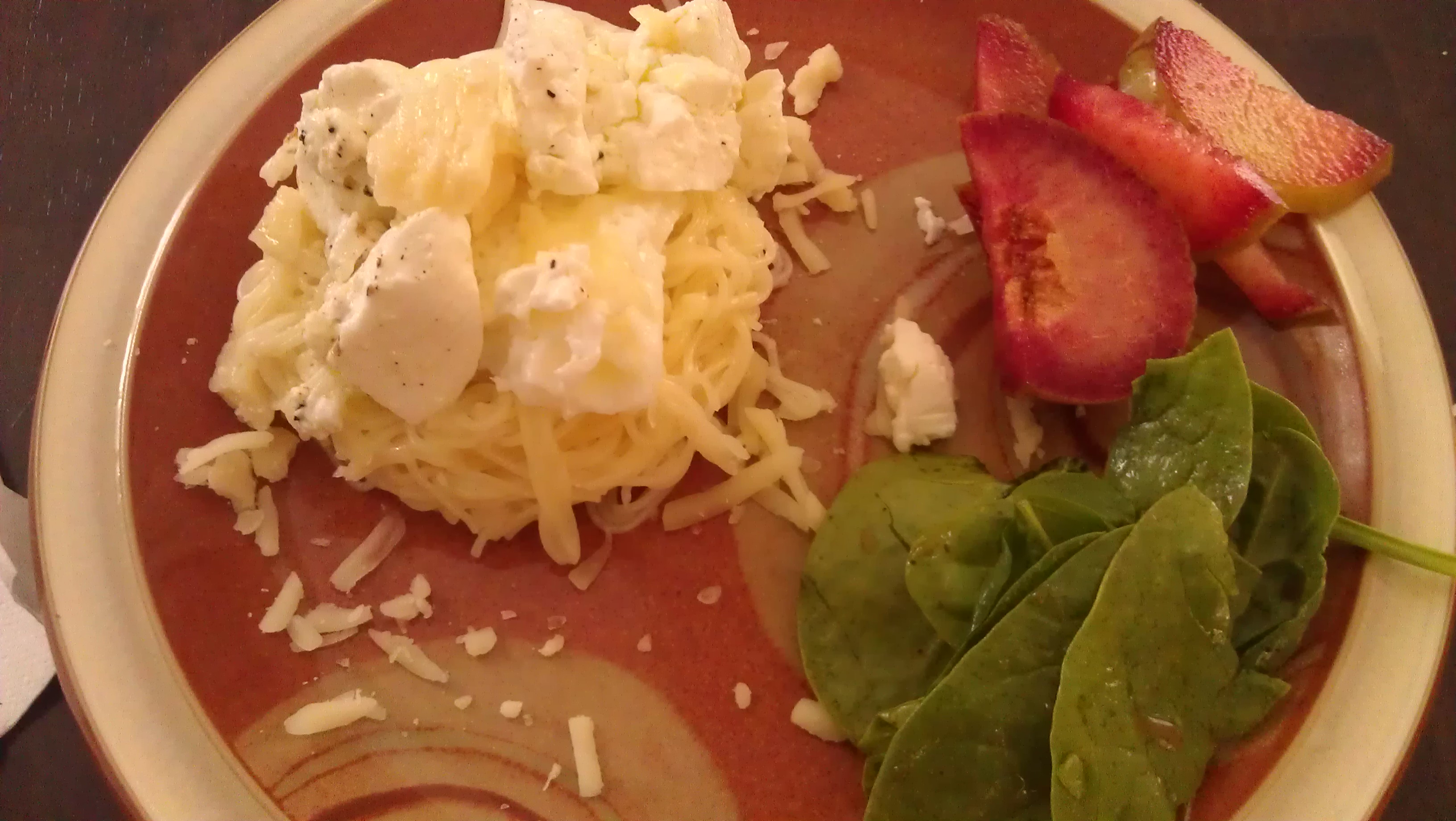
Noodle birds’ nest with roasted feta and poached egg, spinach salad, and pluot. Kids’ portion, in case she didn’t like it.

I watched her shudder at the taste of the plain pasta. The friend who got us into this mess was dining with us said, “You know, the cheese is very salty. Take a little of the cheese and the egg and the spaghetti and eat them together. All in one bite.” Rosí tried it and was quite pleased. She told us about how her mother prepared food by making everything together. Not pasta with sauce on it. Not foods layered on top of each other. Sauce with noodles cooked into it.

And once she settled into eating something we could finally agree on, we hit a few moments of the stride I was hoping we’d find during this encounter.

She explained how she mops at her house every day, because with the windows and doors always open, there is a lot of dust. She told me how much pride people take in their homes and how clean the Dominican Republic is. I believe her, since she scrubbed and mopped my front porch. I’ve swept a porch in my day. I’ve hosed off a porch. I have never scrubbed and mopped a porch. But in her third day here, Rosí did.

She told me how the ripped twenty-dollar bill in her possession would be worthless in the Dominican Republic. “If you come to my country and someone tries to give you this, tell them, ‘Please change this for me.’ Because there are many stealing people in my country and this money, this break? This is not worth any money. Never take this.”

I remembered our conversations the first day about how people in her country rarely pay their electricity and water bills. Because whether you pay or not, there is sometimes electricity and water. And sometimes not. How people only park inside at night because if left on the street, a car would be stripped for parts. Or stolen entirely. She is shocked that people leave their bicycles on the porch in my neighborhood. “Doesn’t someone steal that?” she asked, shocked. “In some places, yes,” I answered. “Here, not usually. Sometimes. But not a lot.”

Today I have begun to wonder what it feels like to not trust. I’m already skittish and try to be aware of my surroundings. To not tempt those who are looking for opportunities to lie, cheat, or steal. But I’m looking for an unusual occurrence. A rarity.

But what must it be like to know that your utility company will take your money and not give you electricity and water? Or that you are paying and your neighbors aren’t? How can you trust your neighbors if you know you’re paying for their utilities because they refuse? How can you bring yourself to pay a company that doesn’t deliver services?

How do you approach transactions if you have to inspect every bill, parse every word, and look over your shoulder?

I’m intrigued. Really. She can’t sample fruit in the store without the riot police descending. She can’t take anything at face value or leave possessions out in the open.

But she made sure, when giving me that twenty-dollar bill, that it was okay. She wasn’t hiding it. She was curious and she didn’t want to stiff me on the groceries. Is part of the pride of cleanliness in the D.R. also a pride in honesty? There may be some stealing persons, but there are many, many proud and honest people?

I mentioned in my post before Rosí arrived how worried I was that we had too many things. That we had accumulated too much that we simply didn’t need. Or that would have better served us as money in the bank.

Is my focus on her stories about theft rooted in an American sense of ownership and property? We seem to value property pretty highly…legally it’s right up there with life and liberty. Or is this a difference not in perspective but of privilege? I rent in relatively affluent suburb of a relatively wealthy part of the country. We are not rich by any definition I know. But I know a very limited number of people from a very limited range of circumstances. Is part of our new mutual reality with Rosí a juxtaposition of wealth that doesn’t know its own wealth and poverty that doesn’t know its own poverty? Am I a horrible bastard for even thinking that way and asking the question? Am I a horrible bastard for not thinking this sooner?

I’m not sure someone has to be a horrible bastard in this scenario. But I do know, that with a lot of feta and some spaghetti birds’ nests, we might begin to scratch the surface of these questions.

And then reality hit

Hosting Adventure Part One, Days Two through Four

“Guests, like fish, begin to smell after three days.”  –Benjamin Franklin*

*The Internet is almost always wrong about quote attributions, as is popular culture. But I haven’t the time or the interest for investigating. Take the Franklin attribution with a huge grain of salt, would you? Someone said that dreadful thing about guests. In my experience, which seems a bit kinder to guests, it happens around day two, not three, and it’s more that they’re blindingly annoying, not smelly. But I didn’t invent bifocals or lightning rods. Allegedly.

The first thing I learned in the past few days to always keep in mind that I’m an introvert by nature and should never engage in an endeavor wherein I will be with other people for the entire day. Or, for instance, for four days in a row without break. Or, for a more ludicrous instance, seventy-eight days. Or so.

This is not, of course, entirely about our lovely international visitor. She has a full-time job and leaves the house nine hours a day. My children have no jobs but still leave the house a few days a week for a few hours. And Spouse has a full-time job that has him traveling 14 out of 15 days this month.

And therein lies a bit of a problem. I had the lack of foresight to allow the universe overlay a new housemate with a houseguest with an absent Spouse with the last week of school. Silly me. Note to self: work harder to plan things out of your control. If not able, self flagellate, then try again.

So remembering that I should never agree to be an extrovert isn’t really learning something.  But I have learned that things we take for granted in our daily lives can be quite shocking to foreigners. I received a text on day two that Rosí, visiting this summer from the Dominican Republic, is terrified of elevators. Never been on one. Didn’t like it one little bit. I did not see that coming. I guessed about the washing machine and the dishwasher.

I did anticipate that she would be confused by the fact that my husband does our dishes and laundry, and that my father cooks all the meals at his house. She told Dad that she would never get married because she can’t cook well. He told her to find a man who cooks. Or to find a man who likes bad cooking. I told her she doesn’t need a man.

Guess which one of those suggestions will be useful to a young woman back in the DR.

Exactly. None of them.

As much as I prepared myself for differences from one culture to another, I thought the primary differences would lie across the Dominican vs. Californian divide. But after a few days of this arrangement, I’m beginning to believe that our largest chasm is that between 40 and 20. Between mother and unattached university student.

Let’s just say I apologized to my visiting father at least a dozen times for my…um…shall we say world view?…when I was 20. I don’t now, as a professional straddling two careers while staying home to raise my boys, shop for leisure. I don’t do anything to my nails. I don’t care about my hair. I have worn the same clothes since I settled into this size a year after my son was born (often for several days at a time without interruption.) And I don’t think this young lady has any interest in the things I find fascinating. So we’re evenly baffled by each other’s priorities.

Rosí and I are going to have a talk tonight because I think one of her primary sources of discomfort is that she doesn’t know if she can ask for things to be changed. She is very direct, which is a cultural norm for her country, but she also seems shy about being impolite. So she tries a food and says without cushion or caveat that she doesn’t like it, but later tells one of us that it needed salt. Goodness, woman, just ask if you can have some salt; don’t starve. She had a cup of tea at work that she described as being dreadful. But later when I made her tea, she said it was just as bad. Until I told her to put more sugar in it. That made her happy. But did she not know to ask for sugar? Did she think it would be rude? I have to tell her that asking to add something to food is okay.

Update: never mind. On her request, I made spaghetti. I freely admit to using jarred sauce. She asked if I forgot the salt, went to the cupboard, got the giant sea salt bottle, and added at least a teaspoon, if not more to her bowl of pasta. Um, she’s not shy. She just really hates anything without Wile-E.-Coyote-allum levels of salt. Fair enough. She just likes potatoes with salt and pasta with salt and crackers with salt. And cheese.

I think I might be in love.

Hosting Adventure Part One

Part One, Day One:

Our international house guest has been in my care for twelve hours. She’s what I hoped for: a delightful, funny, adorable creature who is teaching me a lot about her culture, her country, and the perspective of an Internet-generation adult.

Proto-adult, really. She’s twenty. I had forgotten how important things like clothing and leg-hair removal mattered at twenty.

Our new friend is gracious. She’s been thanking us for everything at each turn. And as I prepared dinner, without being asked, she wordlessly went through the house tidying. As I made lunches for the boys for tomorrow, feeling a bit frustrated that I’ve added another child to might daily chore list, I asked if she wanted to make her own lunch or if I should do it. She furrowed her brow and said, “It would be easier if you do it. But starting tomorrow you must give me responsibilities for the house. I feel as though you’re my mother, and I don’t like doing nothing.”

Díos, mío, how I’ve wanted to hear that from my children. And now, only one day old, this most recent newborn has uttered the words I’ve wanted to hear for years. “Give me something to do that will help you; it’s unfair that you do so much for me.” The other two keep demanding that I help them dig up the garden and pour the dirt all over the pathway to “make a new road.” Here’s a third child who wants to learn how to use the washing machine so she can do all our laundry.

And as impressive as washing machine is, there are many more items we take for granted that have shocked her. She really doesn’t understand “heater.” She can’t stop examining the hardwood floors and the fireplace. She’s poked around the latter three times, as though it might go away if she doesn’t check in. She told me that if someone put wood on their floor in the Dominican Republic, people would think he was crazy. She asked what she was hearing when I turned on the clothes dryer. As I explained, her eyes grew bigger. Slightly bigger than when my three-year old threw a plate at a cafe. She explained in three words and one gesture that in her country, he would have a handprint on his face.

But the biggest jaw drop of the day was when I explained, in detail, what an automated dishwasher does. Her eyes simply wouldn’t blink as she breathed, “magic.”

It is. Think about it.

When we selected some blackberries in the store and sampled them after they were in the cart but before we paid, she was shocked. She looked around as though the grocery police would grab her and throw her from the store. I’m pretty sure she checked her pocket for her passport before she bit the blackberry.

She returned the favor by shocking the heck out of me. If you pay your electric bill and your water bill in the Dominican Republic, you sometimes get electricity. You sometimes get water. But not often, really, and not predictably.

And if you don’t park in the garage at night, your car, or bits of it, will be stolen.

I’m sure we won’t always be able to impress each other. There are some things that are bound to be issues. Hosting a foreign exchange student for three moths will not be as easy as it has been the first half day. And I have only seen glimpses. We’re Berkeley vegetarians. She’s a Dominican carnivore. We eat as much local, whole, unprocessed, organic food as we can. She prefers soda and juice to water or fruit. She told me tonight that, when I make her cheese, mayonnaise, and ketchup sandwich (oh, wow, I just gagged a little), for one day it’s okay to use whole grain bread. But otherwise, that’s for people on diets and she’d prefer heavily processed bread. The delightfully squishy kind where the nutrients are stripped then painted back on. My words not hers. Except the diet part. Seeds and grains are for diets.

Tongue still bleeding from the self-silencing.

She gets significant respect for trying, though. I’ve had her try veggie chorizo, hummus, and a smoothie. On her first day. Hummus is good, she said. But not for sandwiches. Veggie chorizo? “Spicy? Is that the name for this feeling? I don’t like spicy, I guess. I changed my decision.”

So now that I’m better informed than I was during last night’s panic, I can tell you that this university student, with aspirations of a masters degree from a university outside her country, has an impressively open mind. After I explained why we have four different ways of disposing of kitchen waste, she wondered aloud why more cities don’t compost and recycle. She didn’t bat an eye when I told her that Spouse is the guy who does dishes and laundry. She might even win over the little guy, who is quite choosy indeed.

We had a busy first day. There was a lot of hanging up clothes and trying on clothes and hanging them back up, then trying them again.  She brought a lovely assortment of sleeveless blouses and dresses. So I found in my closet several lightweight suit jackets (that fit, thankfully) so she can make it to work without freezing to death.

Because I would hate to lose my new, cooperative, conscientious child to hypothermia.

Adventure Eve

I’ve been trying to downplay the adventure on which our family is poised, but I don’t see any way to be blasé about the fact that tomorrow a visitor arrives. For the whole summer. A stranger from another world will be living with us for three months.

And I might be a bit nervous. Maybe.

A friend asked in an email months ago if anyone would be willing to host a longtime friend of hers in a foreign exchange extravaganza of goodness. The project would involve a 20-year old woman from the Dominican Republic, whom my friends have known since she was a child. Now grown, this young lady wants to have a chance at making a better life by gaining work skills and building language fluency through an established program in the U.S.

She would have a full-time job, my friend’s email noted. Her family has been kind to mine for more than a decade, my friend pointed out. This opportunity would change the young woman’s life, I told Spouse.

So tomorrow a woman I’ve never met will arrive at our house. We’ve cleared the boys’ playroom to make it a bedroom. I’ve written instructions on how to call 911 in an emergency and where to find the towels and soap. I’ve tidied up the best I can and tried to figure out what the hell I’ve gotten myself into.

Because more than the house sharing, I’m concerned at the project I’ve just signed up for. Our family is going to model language and culture to a woman about whose culture I know very little. About whom I know almost nothing. And for whom we might be a very bad fit.

May I note for the record that in an email exchange, she expressed interest in my offer to cook for her what I’m making for the rest of the family. She probably passed out from the shock of hearing that we’re vegetarians. In the same message I explained that yes, shorts are acceptable attire. Except that the summer in the Bay Area averages temperatures in the high 60s.

I’m pretty sure there will be more shocking moments during her trip. A meatless, cold summer might  be the peak, but I have no idea since I’ve never traveled to the Caribbean.

Sure, I’ve read The Brief, Wondrous Life of Oscar Wao. But I’m guessing, as vibrantly written as it is, I still know almost nothing about life in the Dominican Republic, and particularly about this woman’s life. I’ve seen photos of rainwater collection via PVC piping jury-rigged along a hillside and the village market and the local trash heap. But that doesn’t mean I understand the realities and nuances of public utilities and water issues and food availability in our guest’s country. I’ve read her questions about modesty and propriety for single women, but I don’t intuit the full extent to the misogyny of her island’s culture.

Of course, we’ll all learn soon enough.

While we prepare, I’m keenly aware of how aseptically most suburban Americans live. In little boxes with windows and doors closed and locked: boxes with wheels or foundations, we’re still all isolated from our neighbors and fellow commuters, closed off from sounds, temperature variations, and smells. We avoid physical contact with strangers, including trying desperately to keep our bodies free of sweat, odor, oil, and other signs of life. I wonder how differently my senses would process life in Santo Domingo than they do suburban Northern California. And how much of that is based simply in exposure to heat, humidity, sounds, neighborhood, and skin.

I’m also fixated on all our stuff. Dozens of shelves full of books in English, cupboards full of food, a closet full of jackets. Electricity that fails so rarely that outages are big news. Toilets that flush. Hardwood floors. And toys. Oh, good gravy the volume of toys. So many possessions nationally that become so much trash. But trash that isn’t thrown into heaps and burned. Trash that is separated into four different bins and picked up by four different trucks and taken all over the world for cheaper processing.

So I’ve collected large piles for St. Vincent de Paul and Goodwill and the dozen other charities that will take from Americans the perfectly useful items they have grown tired of, not only to clear away the clutter, but also because I’m embarrassed of our accumulation. Nobody needs three colanders. (Even the wordpress dictionary doesn’t think anyone needs three colanders, because it accepts the singular form “colander” but flags “colanders.” I know, WP, I know. I’m working on it.) But I got the second two colanders as a set to replace the one that wasn’t useful. Then I kept the not useful one in case the others were dirty or being used. Because, it would seem from my purchasing, we eat pasta and cherries and salad with such frequency and ruthless efficiency that there’s never a time we can just rinse one colander and use it for the next food.

And as I spiral into a self-loathing, anti-consumerist whirlwind, I realize that what I’m really worried about is that a stranger is coming to live in our house for three months. A grown child who thinks that women are somehow different, more valuable if they’re married. Who has been taught that single women are a threat. Who asks what the heater is for.

Well, she won’t be a stranger after tomorrow.

By about the same time I’ll know more about life in the Dominican Republic than Junot Díaz wrote.

And I’ll know very soon if this project is a lovely respite from spending time with three males who rarely listen to me; if we achieve the ideal co-educational experiment in cultural exchange. Or if it’s a hurricane of unforeseen dilemmas, the solution to which is simply to invest in whiskey, gummy cola bottles, and a new puppy. Because as much as I pretend otherwise, this adventure is either no big deal or quite a big deal indeed, the kind of huge big deal that sends me scurrying toward impossible projects. Like full-time parenting and writing a novel with a house guest and a puppy.

I won’t know for a little while how blissful or gobsmacking my decision to host a foreign exchange human might be.

She won’t know for a little while how awesome or freaking insane her host family is.

So I guess I’ll go gather together more for Goodwill while I wait. You can’t go wrong decluttering, I always say. (I never say that, but wish I were the kind of person who says things like that.)

Wish us luck!

Respite

I know it’s wrong to enjoy sick kids’ sweet snuggling fevers. I know it’s wrong to hope, once in a while, that the whirling tornadoes in the house get the flu just so they’ll stop running for a few minutes.

And it’s beyond despicable to enjoy a child’s broken limb.

But dang, the peace that has swirled through our house since Peanut broke his arm is significantly changing my life. I feel hope and vigor and joy, y’all. I feel this might actually be why people make it through the day and still like their children.

See, a wounded child in pain avoids things that cause him pain. He might, for instance, avoid a younger brother and talk sweetly to him to ensure that roughness is kept at bay. He might stay nestled in bed to play with LEGOs already built instead of screaming in rage that things won’t work or running like a cheetah through the house from project to project. He might even, perhaps, ask to be read to, and put a head on the shoulder he’s so long said he is too old for.

I would never want my child hurt. I’m sad for him that he’s hobbled. But the silver lining is about 90% of the cloud for me, and I’m really enjoying the seachange that has come from this week.

I praise thee, bringer of peace and breathing room

I praise thee, bringer of peace and breathing room

One-armed activities

Well, I’ll say one thing for breaking your arm on a school field trip…it brings out the creative side of your mama. Coming up with things for a seven year old with a broken arm sounds easy enough, doesn’t it? I mean, just because you temporarily can’t bike, skateboard, climb, write, draw, sew, do origami or carpentry, I’m sure there are enough activities in the world to keep you busy for all of June.

So without further ado, here is a list of things that a seven year old child can do, even with a broken arm. Dominant side, naturally. Because when first graders do something, they do it all the way. As close to the end of school as they can manage.

Bean bag toss. Honey, I said toss. Toss means lightly. Gently. Toss, sweetie. Okay, moving on…
Marbles. So if you flick the marble at the other…um, flick. Like this. Not tossing. That was the last game, peanut. Honey, don’t throw the marbles. Okay, let’s try something else.
Puzzles. I know. I’m bored, too. Wanna try tossing the pieces into a bucket?
Board games. Now you’re talking. Let’s play all our games dozens of times. Yay! Okay. One day down…
Blanket fort for reading. Pretty dark in here, eh? Try reading with a flashlight. Oh, right. One hand. Next plan…
Word find and word jumbles. You’re right, honey. Butter does start with butt, and yes, you can circle both words.
Stomp rocket. That was fun. Now let’s go on the roof and get them. Oh, no; not you. You might break your arm.
Soccer. I know you didn’t mean to, but you still get a red card for concussing the defender with plaster.
Bug habitat. Sure, I’ll carry this terrarium around while you look for bugs. No, I’m not napping. I’m looking really closely at this ant hill.
Sidewalk chalk. Wow, your spelling is getting better from those word jumbles. That *is* exactly how you spell butt.
Dictate stories Wow. That was a lot of inventions the character put on his vehicle. Where did he get the volcanic dynamite laser protoplasm? Oh. Right. Of course he grows it himself.
Photography. Take all the photos you want and we’ll make a book from them. Sure, we can take the camera outside.
Hike.
Beach.
Zoo.
Aquarium.
Berry picking.
Berry eating.

Good luck with your summer plans. Ours just got a lot more outdoorsy.

What I did on my vacation

The family and I took a little trip down to Monterey for the weekend.

Visited aquarium. Enjoyed Dennis the Menace playground. Spent copious times climbing rocks at all times of tide.

Climbed way up a rocky bluff to this lovely scene.
IMAG3176

Then down the other side to this shell-deposited beach between gorgeous outcroppings of granite.
IMAG3177

And on that beach, halfway between high and low tide, we stepped carefully around small tide pools, watching crab and snails and fish and anemone adjust to their temporary life in a warm pond.

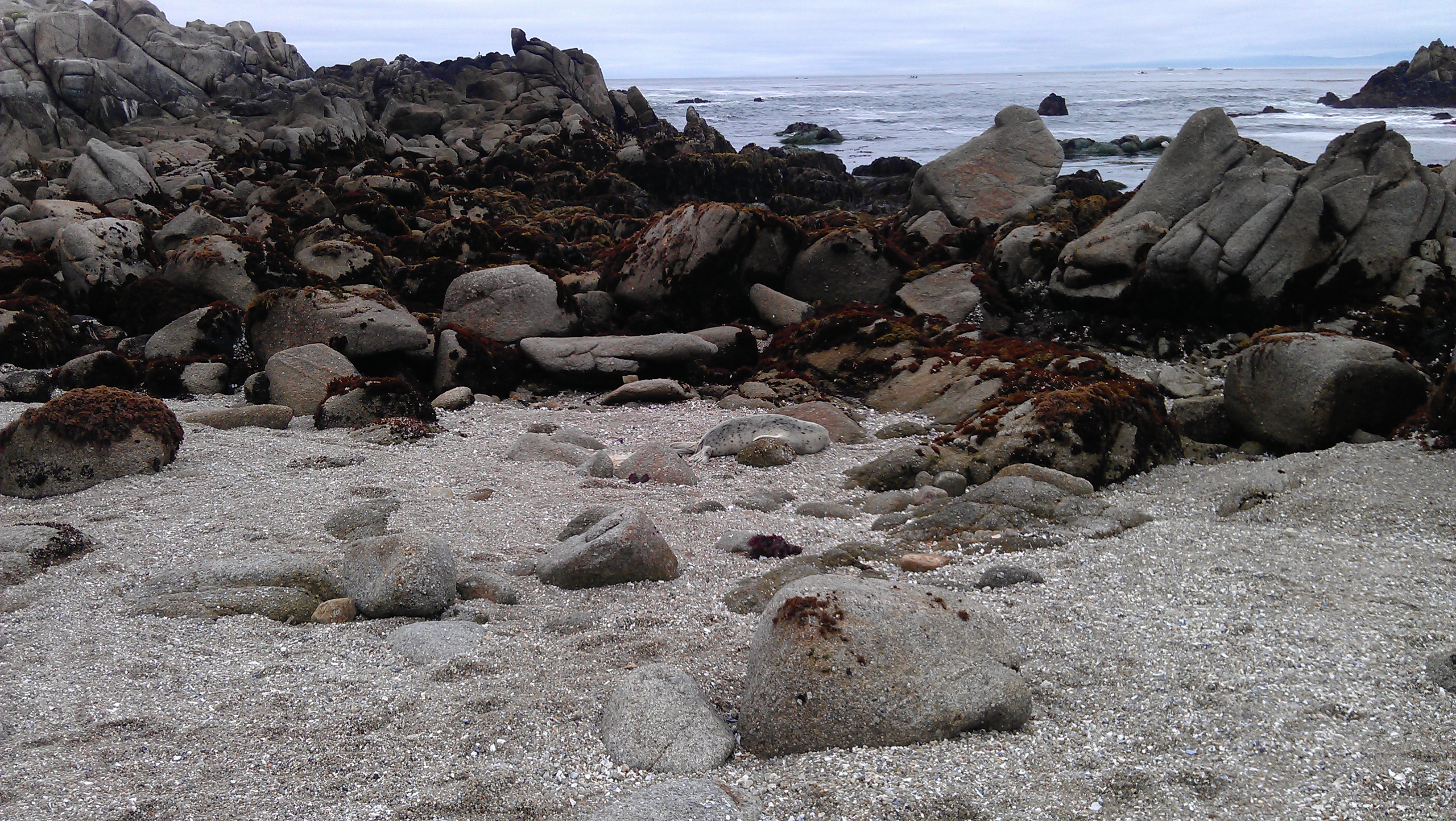
We marveled at a distant rock island, maybe half a mile away, that held three young seals. And we wanted to get closer.

IMAG3175

So we weren’t really watching as carefully where we stepped. After all, we were among only shells and rocks at this point in the tide-pool search.

Do you see that?
We almost didn’t, until we were way too close.

IMAG3175-1

Yeah.

That.

Right there.

IMAG3174-1

Poor little stranded seal pup.

Every ten minutes or so, another family came carefully picking through the tidal zone, and every one stopped about ten feet from her and stared. And she seemed shy. Sad. Lonely. All the anthropomorphic adjectives I could heap on a baby without her mama.

IMAG3173-1

We checked the ground to see how wet it was, debating whether the high tide would really come bring her back to her family.

Everybody else marveled at her and moved along.

The kids kept asking, “Is someone going to make sure she’s okay?” Spouse and I explained about the tide and about how she could wiggle into the water once it came.

But I doubted. And as we walked away I came back three times.

“But mom,” the youngest asked, “is anybody going to help her?”

“Yes,” I said. “I am.”

I googled “report stranded marine mammal Monterey” on my phone. Because that’s why Google was invented, right?

The Marine Mammal Center has a hotline. A delightful creature whose name I forget walked me through a checklist of questions about the seal’s size and health. And location. Lots of details about location. And she dispatched volunteers to the site to check on the pup.

I have no idea if that baby made it back to the ocean. I have no idea if I’m the only one who called. But I told my kids their first lie today. At bedtime, when my little guy interrupted the nighttime songs to ask if the seal pup was okay, I told him that the Marine Mammal Center emailed me to tell me that she got back into the ocean with no trouble.

I should have just said, “I don’t know.” I should have said, “we did our best.” There is no reason to trick kids about happy endings. Heck, we don’t tell them about Santa or fairies or storks, so why tell them that babies are always safe?

Well just this once, I want to live in a world where heroes save the day. Where people like the Marina Mammal Center do their best and fight for the voiceless.

Because isn’t that what Memorial Day is all about? Remembering those who fight for what they believe in?

I hope you’re okay, sweet seal babe. You and every creature on the planet tonight. I hope you’re okay.

IMAG3175(1)

A special thanks to all the heroes who fight for others, in and out of uniform. Happy Memorial Day.

Shake things up

I posted a couple of weeks ago about being overwhelmed and not knowing which sources of stress were worth the anxiety and which needed to be jettisoned.

And I have a few remedies to share, in case you, too, have those days when there is just too much to do. When you have to choose between blinking and breathing, try these:

1. Visit a wise relative. I spend a morning with my grandma and felt refreshed. At one point in a conversation about a neighbor, she said, “You know. the whirlwind of small children is a blink in the span of your life. It feels really big, but it’s just a blink.” She’s wrong, of course, because having small kids for ten years or so amounts to more than 10% of your adult life, no matter how long you live. But the fact that she remembered at her age how challenging the frenetic under-five set is, that she’s seen several generations go through that, and that she didn’t warn me about how much harder teens are all sufficiently reassured me. That people get through this. That it’s not as big as it feels. That things change, every day. And that someday all this 80mph will be a memory.

Perspective offers a long-lasting respite.

2. Meet a friend. In the past week I met, face to face, with four different people—by choice—whose company I enjoy. Drank coffee, watched laugh lines, marveled at grey hairs that weren’t there the last visit. It’s a rather impressive phase of life in which to have good friends you’ve known for a while. My friends are getting older, and in the process honing a more condensed version of the person I’ve always known. A lot of the chaff falls away in your 40s. My friends are ditching the bullshit. They’re glimpsing mortality and deciding what they want to do with their lives. They’re caring for older parents and they’re caring for kids. And they’re still smiling and listening to new music and seeing art exhibits and writing short stories. You can get information, but you can’t get full sensory pictures from email or phone calls or blogs. Go watch a friend’s face while they tell you a story. Really watch them. The process is compelling.

Friendship provides a salve.

3. Change your music. I am, by nature, a creature of ruts. Not just habits. Deep, well-worn grooves. I used to listen to a tape on a loop for weeks without cease. (Hey, that was fancy in my day…tape decks that offered continuous play changed my life. Don’t go on and on about your MP3 playlist. When things are important, you sit with the tape recorder by the radio and you push pause before you hit record and play so that when the song finally comes on the air you can catch it without the sudden sounds of stops and starts by just releasing the pause button. And then to play the whole thing on a loop? Technological nirvana.) I once went three months without changing the tape. That’s some serious dedication (and change aversion, but that’s another story for another post). I do it with foods, too: eat the same foods for weeks at a time until I can’t stand to see them anymore. But feeling panic at being overwhelmed and having too much to do and being paralyzed with stress does not benefit from ruts. Sometimes releasing the valve on the pressure means getting some air in there and shifting the contents. (Not, for heaven’s sake, like the scene in Just One of the Guys. Playlists don’t itch.)

Music informs mood and alters rhythms.

4. Change your food. As mentioned again, I default to habits. Pressed for time and energy, I tend to default to what’s worked before. The same veggies, the same fruit, the same protein courses over and over. Lentil-bulgur burgers. Scrambled eggs with cheese. Bean stew. Stir fry tofu and udon. Pasta. Burritos. Goat-cheese-flatbread rollups. Salad. Peanut butter on apples. Pancake sandwiches. Eggs and cheese in rice. Al prepared with kids fighting around me, as quickly as possible, with stress pressing me to move quickly, efficiently, and without genuine engagement.

So I went to the fancy grocery and found a few small ways to bring adventure to a process that was wearing me down.

Dragonfruit

Dragonfruit

Dragonfruit cut and lifted off peel

Dragonfruit cut and lifted off peel

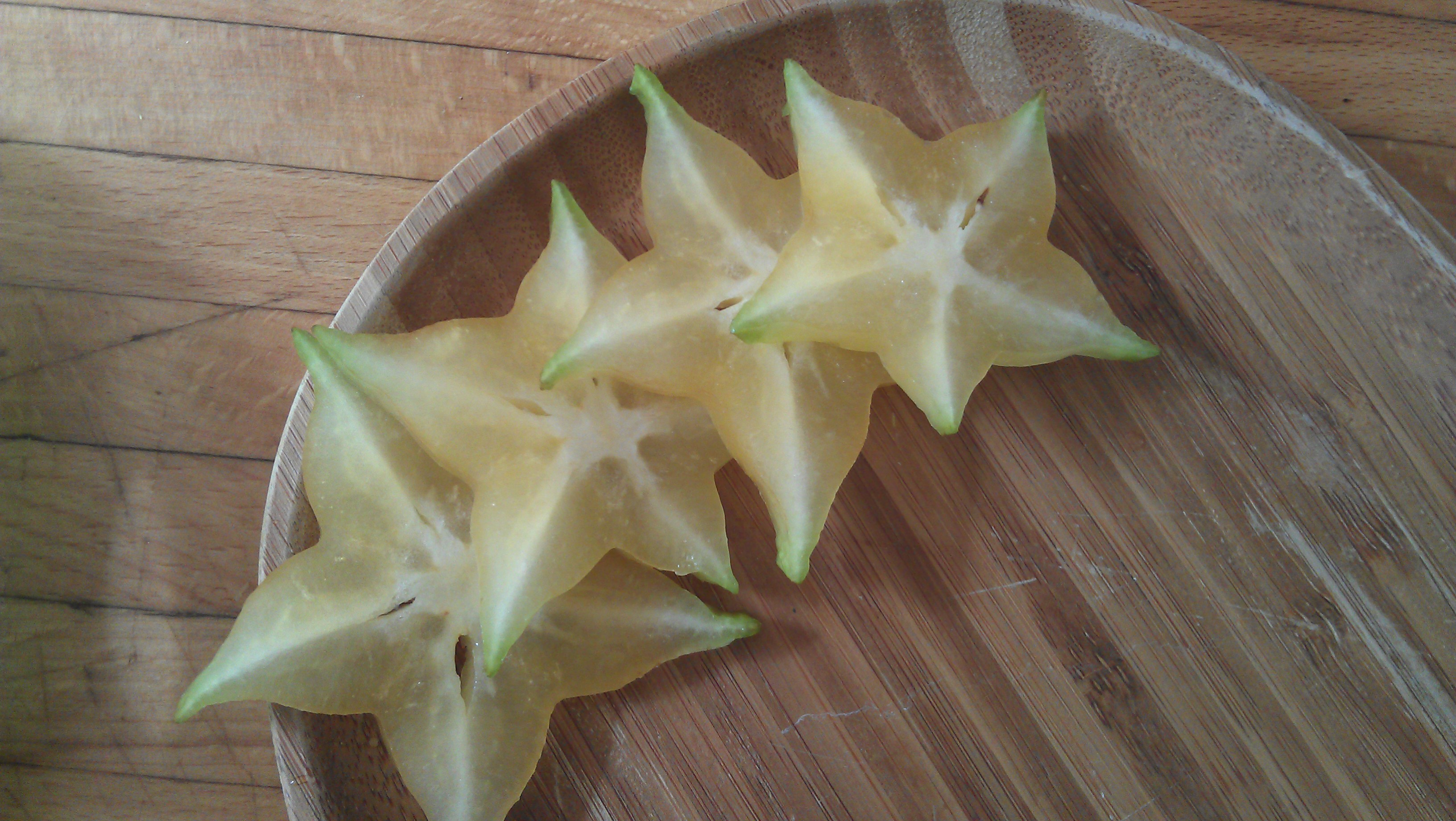
Star fruit

Star fruit

Passionfruit

Passionfruit

I quickly cut and arranged the fruit on a plate. Then I made a typical dinner. And we had adventure night. We all sniffed and tasted the fruit, compared notes. We talked, we used our senses, and we spent at least five minutes present, aware, and engaged. Together. And ate our so-called boring, expected, normal dinner with a sense of newness.

Adventure engages all your senses.

Adding a knowing grandmother, several good friends, some new music, and dragonfruit to my week, I felt as though things had really changed. Spring cleaning for the rut of stress and fluster. I’ve begun to remember that life is pretty manageable. That we’re lucky and that it doesn’t take a week in the tropics to feel as though we’ve restarted. That sleep is important and so is art and writing and family and food and exercise. And that a little taste of each whenever I can get them is what my current reality. Little bites of adventure, little efforts at balancing and exploring and listening and smiling are exactly what will fit right now.

And that’s pretty adventurous for me.