A truer course to steer

Boys:

I hope that each day I teach you a bit about how to turn toward light and away from dark.

I don’t mean that you need to be a creature of the day and avoid night. For too long our culture has associated night with evil and light with goodness, so linguistically that just sticks. Forgive me the sloppy metaphor, sweet one. I mean only that my sincerest wish for you is that you choose, actively, to move toward goodness. Always.

Don’t be fooled by the language of light and dark: being good and kind has nothing to do with being cheerful. Be chipper or be cynical, but I will always nudge you toward good. You can be maudlin and kind. You can be morose and nurturing. You can. Really, given what exists in this world, you must. We all must.

Because when you have to choose what kind of person to be, how to map your course and true your compass, you have to decide. Are you going become a person who hates or a person who loves?

I had some time today. Some unusual, luxurious time to read and immerse myself in humanity. To see what we, as a culture, are up to.

Results are quite varied. And instead of just wandering aimlessly through society’s publicized highs and lows, I wanted to focus on the best humanity has to offer this week. Really, we have, as a culture, been wallowing a bit in the terrifying and hateful and exhaustingly dreadful for a while. Certainly it’s important to know about and fight the yuck churning up the worst of humanity, so we can hear people in need of a voice, a hug, or a place to stay.

I spent a bit of time roiling with anger and loathing at articles like this. In it, a man who professes to know literature dismisses most of the people writing, most of the things they have written, and most of the knowledge we have, as English-speaking nations, cultivated over the past century. He refuses to engage with other opinions because he thinks he’s pretty awesome, exactly the way he is.

I stopped reading after a few paragraphs. Not because he’s a dreadful man with views I find appalling. But because I have better things to do with my time.

David Gilmour’s interview speaks of a core that refuses to hear other realities. Not listening when someone speaks about their family or their work or their passion is a pretty bleak way to live. His words are about ignoring heart.

And I reject that way of being.

So I clicked another link. Someone I trust told me that an article was important. That this is what humanity looks like. Prabhiot Singh lives his life to offer the best of himself to those around him, allowing himself to be affected by his community and finding, even in truly horrifying situations a reason to reach out and help.

You get to choose, of course. You get to decide whether to wallow in self-aggrandizement, closing your mind to people who don’t think the way you do. Or to learn from experience and not let anger and hate and truly disgusting behavior sway you from what you know is right.

I hope you see, in the people we surround ourselves with, that what matters most is kindness. That what matters is struggling to make things better, in whatever way you define better. That life is about deciding what’s right and fighting for it.

I hope that you turn toward people like Prabhjot Singh. People who find gratitude, who reject hate by continuing on their path toward love. People who deserve to know what a wonderful person you are, who can bring out the best in you, and who can teach you about other ways of thinking and doing and being. So that we can all change the world toward what is good. What is kind. What is true.

I hope that’s what I’m teaching you. I’ll keep trying. Because beyond keeping you safe, my job is to show you how to share the best of yourself with the world that is so lucky to have you.

Item #12: Bake Muffins

I just wrote “bake muffins” on my to-do list.

maybe not a metaphor for my list making, but probably totally a metaphor for my list making

maybe not a metaphor for my list making, but probably totally a metaphor for my list making

I’m not saying I make fabulous muffins. I enjoy baking, my kids like muffins. And I’ve made dozens of recipes over the past six years or so, some much better than others.

So making muffins is not a big deal. It’s not “overturn landmark court case” or “pay bills.” It’s not “submit proposal” or “email President for advice on major issue.”

It’s just muffins.

But I’ve been meaning to make muffins for about a year. Haven’t remembered.

Let me repeat that so I can bask in my ludicrousness: I can’t remember to ask my kids to measure some flour and sugar with me. For a year. Despite intention, despite planning.

I just plain ol’ forget.

I’ve gotten to the point where I have to jot down reminders to call my friends. And to plan the weekend. And to mail a package that’s been on my desk for two weeks.

Two weeks. And I have to write a note to remember it. Sitting right there, looking at me, and I won’t remember unless it’s on the list.

Maybe I have list dependency. Maybe I need more sleep. Maybe I have early onset something. Maybe I have childbirth-onset something.

Or maybe I refuse. Maybe deep down I know there are perfectly good muffins at the store, and I have other stuff to do without spending 20 minutes sifting and whisking. And cleaning up that which resisted sifting or whisking.

Regardless of the cause, it seems that it might be a cry for help, that “bake muffins” on my list.

So tomorrow I’ll make muffins with my kids. Or by myself, after they go to sleep. Or not at all because who really needs muffins, anyway?

Anything lingering and lingering and lingering on your list? Does it remain there because you forget or because you passive aggressively forget?

Worst child ever

This is seriously, genuinely an email I sent my parents last night.

Background: they live about five hours from the floods in Colorado, and it has taken me several days of awful news of intense weather-related devastation quite far from them for me to get off my butt and write.

Observe why I am the least likely adult child to be adopted anytime soon:

“It is customary to call one’s parents to profess concern about their safety and well-being when there is massive flooding hundreds of miles away.

But I’m a callous bastard who only calls if the flooding is, at minimum, in a neighboring county. So I  hope you’re not too soggy, I hope you’ll call if you’re in need or danger or dire straits.

We’re fine, we’re busy, we’re hale and hearty. And even though we’re callous bastards, we hope you’re all of the above, too.

Thinking of you, but not worried, because I’ve taken geography and am not dumb and also have The Googles, which tells me your last flood warning was July 31 of this year. I sincerely hope those mid-summer waters have subsided.

Considerately yours,

Your most bastard-y of your two rat-bastard children”

See what can happen if you parent your children reasonably well? What an ingrate. I submit the above as evidence that you should hire a sitter and run off to a tropical island, because your kids may never even email to see if you’re alive next time there’s flooding hundreds of miles away. And if they do, they might sass you.

Sheesh. Kids these days.

Caught a case of the fuckits

Oh, good gawd I’m in a mood.

My children are adorable. And wakeful and needy and hungry and whiny and male, and I just don’t care anymore. I don’t care if they eat complete meals. I don’t care if we remember to do our nightly meetings and our family meditation and our dinnertime highlights and lowlights conversation and our homework and our vitamins and a bath.

I don’t give a flying fig newton right now.

I got myself elected Preschool Board Vice President, and I’m going to warn you, if you don’t want to see behind the scenes of a 200-person cooperative, do not run for elected school board. Good heavens there’s some fraught interpersonal fiascos and some seriously tedious human resources stuff and some exciting opportunities that take seventeen hours of follow-up going on up in there. It’s possible for that part-time, unpaid job to be a bit more work, but I’m not sure I want to complain yet about my own insanity for signing up, since it’s only September.

And I don’t give a flaming foxtail right now.

Now that both boys are in school, I have a whopping two hours to myself, two days a week. Yeehaw, y’all. Don’t even know what to do with myself for two whole hours twice a week. Except maybe the six trillion items on my list that have been half done since my darling eldest was born seven-and-a-half freaking years ago. So I have plenty to do and four hours to do it in…and you know what?

I don’t give a frisky firefighter right now.

The process to schedule a windshield replacement for my car took half an hour, during which my preschooler tried to assassinate me. The four-HOUR window I chose for this morning was, of course, blown off by the windshield-replacement-expert-person, who rescheduled with me moments before the window expired. He offered me an hour slot smackdab in the middle of my two-hour freedom window.

I don’t care. Everybody waits for repair people. Everybody complains about the waste of time. Everybody is busy, everybody is exhausted, and everybody is just trying to get by.

So I don’t care. I’m going to pour this bowl of broken tortilla chip pieces, smother it in salsa, and eat it with a spoon. Because I just don’t see how I can, in fifteen minutes, write a book, read a book, do yoga, take a shower, set up a second-grade science project, email people for babysitter references, drive to the armorer, write get well cards, mop the floors, watch a movie, start a strategy project, update my resume, look for jobs, post useless crap on craigslist, or write a blog post.

So I’m not going to. Fuckit. I don’t care. I’m going to sit very still for one whole minute and see what it feels like.

Crap. I forgot to mow the lawn and call to reschedule a doctor’s appointment. Again. Gotta go.

Caught between a rock and a moderately challenging place

The week before school started and the first week of school, Peanut turned his anxiety about starting second grade and his smallness in the face of big change into kindness toward his brother. For the first time in their lives, we had full days of genuine cooperation, joyful play, and sibling kindness. They’ve been nice to each other before, but it was always short-lived.

Late August and early September were just sibling heaven. I memorized the feeling of joy at watching them lead each other in play, offering each other kind words and gentle reminders that they, together, are a team. I felt down to my bones the calm of an absence—absence of fighting and teasing and retaliation—being filled with hope and love. My adrenal glands ceased production of adrenaline and my body started to recover from the stress of the past two and a half years. Okay, three and a half years. Okay, four and a half. Ah, hell…eight years.

I am so grateful for that eye in the storm because it taught me what might be.
What will be.
What won’t be. Specifically, incarceration and millions of dollars in therapy.

And then it changed. Peanut got impatient and mean. And I’ve tried to piece together what changed.

Because I really want that lull of sibling peace again.

And today I knew. Because for the first time since the day before kindergarten, he cried and told me he didn’t want to go to school. That he wanted me to come to the classroom with him. That he wanted to go home.

I hugged him and told him parents aren’t allowed in the classroom yet, by the teacher’s request. I reminded him we had an afterschool date planned, just the two of us.

I told him he would be okay. I told him he’s kind and wonderful and that he works hard and listens well, and those are the things that make school days go by quickly and productively.

Mostly I lied.

And I died a little. Because I wanted to take him home.

The first week, he was at an ideal table with two girls he knew, both of whom are bright and kind and silly. And who follow the rules. My son, the defiant, willful, rude creature at home, is a rule follower in public. He’s very cautious and does not believe in rocking the boat. He wants to play and have fun and fly under the radar. He values colleagues who do their work and leave him alone and engage in occasional harmless silly behaviors, not disruptive shenanigans.

Well, a few days into school the teacher moved last year’s Biggest Frustration right next to him. And the beginning of the second week she changed his table entirely to the one with two of the class’s Most Frequent Disrupters.

He’s devastated. He’s trying to muddle through and acknowledge that he has no power in the situation. But damn, that’s a rotten place to be. Powerlessness sucks.

I asked him to brainstorm solutions. Every night the whole family talks about their favorite part of the day, their biggest challenge, and how they handled it. The seating topic has been his biggest challenge for at least a week. Tablemates kicking each other under the table, jostling the table to break others’ concentration, jolting into neighbors’ arms while they’re writing.

“That sounds like a lot to handle,” I said. “How are you going to address it?”

He suggested just trying to avoid them.

“That’s a possibility,” I said. “What else is there?”

“I guess I could tell them to stop.”

“True. Any other options? Best way to find the right option is to think of as many as possible.”

“I could ask the teacher for a new table. The one with…”

As he fantasized about being at the table with the quiet and respectful kids, I thought about the difficulty of being introverted at school. I thought about the very different challenges of kids who have processing differences and disturbances at home and insufficient support systems. And the ones with mean streaks.

I know that my earnest, sweet, lovely child will have challenges his whole life. I know that he has to learn to work through the difficulties to prepare for the real world. I know that colleagues are often rude and brutish and stupid and lazy and all manner of terrible, so there’s no need to protect him now from what he’ll eventually find at work.

I know that life is not easy for students with neurological and biological and sociological challenges, either.

But I want so badly to pull my kid out of school forever so we can face the world together. Without quiet kids or mean kids or disruptive kids or hardworking kids or irritating kids.

Just me and Peanut. The way it used to be.

I also know I will serve him better if I teach him coping skills for life’s annoying jackasses, instead of teaching him to run to Mom.

So I’ll just cry a lot while he’s sleeping, and gently teach coping skills while he’s awake.

But man, I totally want to teach him to run to Mom.

How do you handle wanting to protect your child(ren) from all that hurts them? Tough love? Pull them out of bad situations? Teach them kindness and strength and hope for the best? Cry and overeat and hope that things are never, ever hard for your family? [Scratch that last one. It was a hypothetical that I completely, totally made up. As a joke. Yeah…a joke.]

How do you talk to a friend with cancer?

I’ve found in the past few weeks that the fastest way to kill a blog is to post long, depressing content about a challenging houseguest.

So now I’ll revive my blog with everyone’s favorite topic: cancer!

I’ve pointed readers over the past year to my friend Jay’s blog to read about his amazing perspective and approach to life. And to parenting with cancer.

He posted his answer to a question: How do you talk to a friend with cancer?

Please read it. It might help with people in your life who is struggling. I hope none of them have stage IV cancer, but if they do, maybe discussing this will give you another reason to connect.

And if someone is struggling with another type of crisis, maybe his post will help you connect with them, too.

Because heaven knows we all , genuinely, need reasons to be human with each other.

Go read his post.

So close and yet so far

I’ve tried, y’all.

I welcomed a lovely young woman into our home in the hopes that we would all—foreign exchange student and host family alike—learn from each other.

And we have.

But when she charged upstairs to find out when Anne Frank died, then excused herself to go back to watching a movie downstairs, I felt deflated. “Can’t we talk about WWII?” I want to call down the stairs. “Wait! How do they teach the Holocaust in your country, because Anne Frank’s diary has proven a useful tool to introducing the horror to school-aged children,” I want to bellow towards her room.

*Sigh.*

Another change at true cultural exchange lost to the draw of Skype and YouTube.

Our Dominican houseguest brought a stack of thrift store finds to my home office for show-and-tell. She asked me if “Vagina Monologues” meant what she thought it meant. “Yes, and no,” I began, wanting to have a discussion about domestic violence and talk about female power and patriarchal structures and rape in India. But she grinned and said she’d have some explaining to do back home when she wore that shirt, and skipped off to pack her overstuffed, 700-pound suitcases. (You’re welcome, DollarTree. Your third quarter profits are predominantly courtesy of this Dominican-American exchange.)

If a mama can’t get some good conversation going about Anne Frank and Eve Ensler, then there doesn’t seem much hope for this pairing. Seriously.

Sure, sure, we talked poverty and cancer and AIDS protocol adherence. *Sigh.* I guess that counts. <Pout>

But seriously. Wouldn’t you want to know about how they teach history in other countries? Feminism? Experimental theater?

What? That’s just me? Poor Rosí got the weird end of this deal, didn’t she.

*Sigh.*


Translating charity

As our foreign exchange experience comes to a close, I’m marveling at how little I know about Rosí’s culture. I don’t mean the little stuff. I know Dominicans drink their coffee small, strong, and syrupy sweet. I know that being a pedestrian in the Dominican Republic is hazardous to your health. And that following the traffic laws there is hazardous to your health, too. I know that few Dominicans pay their utility bills because the electricity, water, and Internet are often off for hours or days at a time. As in several hours a day, every day. Nothing is reliable, she says.

I know details. But I don’t know how that feels and informs assumptions.

When I first learned Spanish, reflexive verbs fascinated me. In particular, I was (and am, still) obsessed by the differences in language wherein your thought process and language output say “my leg broke itself on me” rather than our apologetic “I broke my leg,”or the passive “I am called by others this name” rather than our ownership claim, “my name is.”

I haven’t thought much about these linguistic differences while Rosí has been here because she speaks to us in English and her challenges are not those conventional differences. In fact, her biggest colloquial struggle, for at least the first month, was saying she wanted “light” instead of “a little” of something. She wanted a light bowl of chips and a light minute to get something done. Her predominant linguistic challenge is pronouncing vowels correctly, i.e., the lazy-mouthed American way. the schwa is not a Spanish sound, fyi.

But yesterday, her confusion about an email reply she’d gotten confused us both.

About halfway into her stay, Rosí proposed creating and funding an animal shelter back in the Dominican Republic so she could attend to all the strays running the streets of her community. She asked a charitable arm of the organization that got her here to the United States for a contribution to her cause. They turned her down and told her to try something more modest.

So she applied for funding for a friend’s chemotherapy.

The organization emailed her to praise her idea and tell her how worthy the cause is. And they told her that she just needed to organize an event or fund drive or project to which they would contribute. They gave her several examples, including a story about a woman in a similar situation who organized a party for the cancer ward of her hospital. The charitable foundation contributed to that party.

Rosí simply didn’t grok.

“I don’t understand,” she said. “I have to do something and then they will give money? So how do I get money to do an event or a project if they don’t give it to me? Why would I do something so they will give me money, if I can just ask for the money and get it for him? That’s ridiculous.”

We talked at length about ideas she could develop that would provide the trigger the foundation wanted: a way to contribute but not completely fund something. A project that would show her, Rosí’s commitment, so they could help fund her efforts, but so they weren’t just giving cash to one person.

She seemed flabbergasted. And livid. She had a worthy cause and she wanted funding, and she didn’t plan to do anything. Asking for money toward a worthy cause was doing enough.

I asked our mutual fund if I’d explained it well. I was baffled by our foreign exchange guest’s response.

But our friend explained succinctly. Where Rosí lives, there is substantial need. Someone identifies the need, raises funds, and arrives with cash. In short, Rosí watches charitable funds being delivered, not being gathered. She sees problems addressed, not to the process of identifying and measuring the problem and designing a potential solution.

I’ve marveled since high school at what it means to think of your body as something that breaks itself on you. Or the world view that develops from thinking you don’t so much own your name as receive it from others. What’s it like to think that charity is something that arrives, not something you really, really ought to do because you empathize but can’t actually fathom?

I thought about how we approach charity in this country. Throw money at someone’s idea for fixing something that’s wrong. So many words in that sentence sound problematic, don’t they? Who determines what’s wrong? Who chooses the fix? Why do we fund other people’s ideas rather than generating our own? And why throw money at need rather than spending time or educating in the interest of change or…

I thought of the op-ed by Peter Buffett, who argues that we’re going about charity all wrong. I thought of conversations I’ve had with clients, predominantly low-profit and B corp organizations who want to change the world, and the barriers that include trying hard not to just slap an American solution onto a decidedly non-American challenge.

Shouldn’t we go about charity differently? Are we swooping in with dollars and dropping them off and flying off again to our next project? Are we engaging the people for whom we’re doing charitable work to ask what they define as the problem and how they envision solutions?

I have absolutely no answers right now, but I’d like to hear your thoughts. When the need in the world seems overwhelming and we want to facilitate the solution, how do we identify need and how do we design solution?

And should we just keep writing checks to help? Is it helping? I’m not being cynical; I’m completely sincere. What is the best use of our passion for help and change and fairness and equality and rights and…should we choose one issue and focus? Should we research and become part of the charitable organizations’ resource pool? Should we close our mouths and listen to the underlying questions, hear the answers to those questions?

That’s where I’m starting right now. Closing my mouth and listening to your ideas.

Foreign Exchange: the straw that broke the camel’s back

Culture clash 2013!

Our foreign exchange student is a big fan of all things chemical. She prefers bread with long ingredient lists, loves pasta from a can, adores adding bouillon cubes to her cooking, and can’t go for more than an hour without using some sort of fragrance-infused toiletries.

Her shampoo, conditioner, shaving cream, toothpaste, perfume, body lotion, face lotion, candles, nail polish, styling products, and soap sit in a row atop her dresser downstairs and seep phthalates into our house. The bottles just sit there, even when closed, and reek.

It doesn’t help that, after more than a decade of completely fragrance-free products, I can smell perfume a mile away. Nor does it help that those fragrances, inherently toxic, give me a headache and nauseate me.

I’ve gotten to a point in my hyper-Berkeley-ish-ness that I want to rescue people who reek of perfume. It’s not nice to be holier-than-thou, but I can’t help it. I want to hand the chemically-addicted an article on the neurotoxins found in fragrance and beg them to change their ways.

I’m not dreadful, though, so I say nothing. Not about my mom’s hairspray or my neighbor’s sunscreen or my father-in-law’s cologne. And not this summer when I have to close the bathroom door and run the fan for hours after our Dominican visitor takes a shower.

But today I’m so furious I can’t stand it.

Rosí asked me how to use the washing machine, and proudly did her own clothes yesterday.

But she left a trial vial of some hideous cologne in her pocket, and its contents leaked into the washer. And dryer.

So now my family’s clothes, towels, and napkins freaking reek of cheap cologne. I’ve washed four times, with baking soda, with vinegar, and with non-toxic eco-friendly soap.

The whole house stinks. When I walk into certain rooms I want to throw up. Every time I enter the house I wonder if a group of misguided teens has shellacked themselves with Axe body spray and wandered the rooms of my house just to torture me.

It’s not all about me, of course. When I handed Rosí the near empty vial from the dryer and told her that her perfume had been through the wash, she seemed devastated.

“Oh, no! I’ll have to get more.”

If anyone would like to host a foreign exchange student for a week, please come now. No, seriously. Now. Because there might be an international incident soon.

Really soon.


Foreign exchange: the waning days

As we come into our last week hosting a foreign exchange student, I find myself wanting more. It’s hard not to be disappointed that the arrangement didn’t go as well as I’d hoped.

I wanted to show our guest all the best of our area. But she usually turned down offers to take her with us. So I took my boys to museums and mountains, events and the coast. And Rosí stayed home, watching movies and talking to friends and family on Skype. She slept the weekend sleep of the single and newly adult.

Ah, I remember that sleep. In the month after college and before work started. I would wake from daytime naps terrified that I should be reading something for a class. I still recall the visceral relief at remembering: I didn’t fall asleep by accident while poring over a book. I fell asleep on the couch watching vapid television. Because I could.

Mmmmmmm. Vapid.

Part of Rosí’s reticence to do what I thought would be an ideal cultural exchange is that she values downtime. By values I mean protects and treasures, and by downtime I mean days of doing exactly nothing. She told me that she believes the weekend should be for rest. She cleans and organizes her room late Friday night and genuinely wants to do zero Saturday and Sunday. I think if she could set up an i.v. for caloric needs she would.

I don’t know where you live or what happens there, but the people I know cram their weekends full. Weekdays here are dominated by work, school, and obligations that leave most of us weekday-isolated, solitary, and tasked. So the weekend is our time to see people and go places we can’t normally be. Day trips, gatherings, errands, events; we spend every waking hour on the weekend doing something. Part of that is the reality of having children. People with kids don’t sleep in. And people with two young boys generally can’t just stay home and chill. If we’re not out of the house by 8:00 a.m., there are monumental fights. Because the boys are bored. So we go hiking. Or scootering to a fabulous bakery. Or driving to see friends an hour away.

We’re not scheduled to death, but we’re not staying home, either. We relax by actively seek and find fun. But that’s not relaxing to Rosí.

Our mutual friend once planned a weekend of travel with our Dominican visitor, who said, “Do you do something every weekend?” She seemed exhausted just looking at the list of weekend activities.

We go. We do.

And Rosi just doesn’t want to.

So my sense that the exchange, which is almost over, has been in vain is the result from measuring with my own gauge. If I’d been in another country for three months, I would have spent every waking hour trying something new, talking to locals, reading, and exploring. Her goals are clearly different. Perhaps she’s found the whole summer worthwhile.

Her English is certainly better. She’s had her share of experiences. She has purchased gifts for friends and family. She has gotten her money’s worth out of Skype and her international cell phone plan.

Asking if that is enough is none of my business, really. This isn’t my journey. This is hers.

And shame on me for thinking this should be fun for my family, educational for all of us, and useful in some way. Expecting an experience to be productive is using my lens to evaluate someone else’s situation. And I really have no right to that evaluation, right?

Dental guilt

Raised by a dentist, I have always held dental hygiene higher in importance over most other personal hygiene. I’ll skip shampoo more often than advisable and I’ll forgo shaving. But I have to brush and floss twice daily. Because that’s what people in my family do.

And I’ve brushed my kids’ teeth since the very first one erupted July 9, 2006. I did not need to look that date up, because I know my children’s dental histories.

When Peanut was diagnosed with a cavity at age 7, I felt shock and sadness. We’d been slipping a bit on the brushing, and had remembered very few morning toothbrush communions that year. We had split parental duties a bit and I brushed the younger child while Spouse monitored and rebrushed for the eldest.

But Spouse is not as dentally retentive as I am. And he let two minutes become one. Or less.

So after the cavity was filled I resolved to do all the brushing myself.

At night.

In the morning, though, I reminded Peanut of his jobs and wrote (and drew) a morning chart as suggested in The Secrets of Happy Families. His jobs were to get dressed, eat breakfast, brush teeth, pack his backpack, and check the weather to decide on shoes and jacket. But he rarely brushed in the morning. And I started to rely on Spouse again during the interminable evening routine. Chaos. Screaming, wailing, running, tickling chaos. So once again I brushed the little guy while Peanut increasingly took on his own dental hygiene.

Second cavity at age 7.5.

Both have been in permanent teeth.

Both, I have to note, have been without dental insurance.

And both are my fault.

Yes, I should be able to give a seven-year-old child a task and expect him to do it passably well. But I suppose there’s no need to get petulant at having to ask repeatedly and remind and plead and cajole and glare and remind again. I suppose I was wrong and it’s every parent’s job to ask seven times every single day for a basic and important task to be done, right?

Yes, I should be able to trust his father to brush him well after the initial juvenile pass. But I guess there’s no need to rely on other parents in the family to do a good job with something as important as dental health. I guess I should have to brush three mouths three times a day if I want us all to be cavity-free.

I guess.

So for at least a night I laid awake, terrifically disappointed in myself that my small child, for whose health and safety I am wholly responsible, will for his entire life have two molars that have been drilled and filled with foreign substances. And that will probably, in decades, need to be further drilled and additionally filled. It’s my fault that he will probably also have potentially toxic (though BPA-free) sealants on his teeth.

That he is broken. Invaded by bacteria. Vulnerable. Weakened. Compromised.

All because of me.

And then I woke up and thought of all the things I try so hard to do right. Food and kindness and respect and exercise and reading and science and math and listening and vocabulary and five-point harnesses and non-toxic lunchboxes and lead-free backpacks and friendship and history and family and sunshine and sunscreen and connection and nature and…

I stopped.

And thanked goodness for dental science and dentists and glass ionomer and resin composites. For disclosing tablets and timers and hygienists who teach what a child will not believe from his parents.

For lessons learned from making mistakes.

And for peace following acceptance and a plan to move on.

Maybe I’ll sleep better tonight. Right after I brush my teeth.

How bipolar is bipolar?

Just how Dr. Jekyl/Mr. Hyde do I have to get before I can self diagnose as bipolar and self medicate with alternating doses of chocolate and cabernet?

I’m asking because spending a lot of time with a three-year-old (again) and carefully observing our seven-year-old, and adjusting to a foreign exchange student are all making me…um…how do I say this…volatile?

In one moment, our family is a unified ball of bliss, talking about what makes us grateful, in the backyard while slurping down locally made ice cream. In another, I’m silently plotting a scenario in which I lock them outside and call the old-school cartoon truant officer to take them to the pound. (Or is that the dog catcher? I don’t care, really, since this is 2013 in Berkeley and everything I’ve said in this paragraph is so patently offensive to the current culture that I’m going to be taken away in a paddy wagon, anyway. Ooops. There I go again. I don’t care. I’m holding on too tight, Goose. Except that it should be tightly. And I doubt I’ll ever hold on so tightly that I say that I’m holding on too tight. So I’m clearly totally fine, right?)

Our lovely houseguest is trying so hard. She’s curious and attentive. Sometimes. When she interrupts a conversation to ask about Anne Frank I’m too engaged in the answer to notice she totally just interrupted. When she timidly asks if the T-shirt she just bought, emblazoned with an ad for a performance of The Vagina Monologues, means what she thinks it means, I’m too intent on explaining performance as a way of bringing violence out of the dark to remember that she’s just spent more of her money on crap she doesn’t need.

And she’s direct. In my best moments, I’m proud of how adventurous she is, quite aware of her challenging status as a stranger in a foreign house, doing her best to engage but not get in the way.

But when I’m not vigilant, a nasty little creature takes over my brain and wonders why on Earth our sweet temporary family member is so impossible. It’s too cold here every minute of every day, until a heat wave. And then woe is her, it’s so hot. Our food is terrible and awful and we are just crazy to eat the way we do. And then she supposes this homemade cookie is okay. “It’s okay, I guess.” Well then you can hand it over, Missy, because if my cookies aren’t good enough for you to smile and make yummy sounds, why then I’ll eat that one, too. She’s so intrigued by everything and can we please take her everywhere we go, but oh dear that’s too boring and can she take a nap in the middle of a potluck? She’s dying to go running and can I please take her running and when are we going running? But then when I get up at 5:30 a.m. to take her for a jog, after one block she’s dying and did she not mention she’s never been running before?

Sheesh. Teenagers.

Which brings me to the three-year-old. A delightful blogger tweeted a few weeks ago that she’d rather parent a two-year-old for seven years than a fourteen-year-old for one year. I begged her to please tell me she was kidding.

You already know about Three. I don’t need to tell you about Three. All I’m saying is, I feel a bit bipolar courtesy of the insanity that is Three.

Cute. Hitting. Adorable. Screaming. Deliberate. Random. Focused. Crazy. Kind. Mean.

And Seven is his own ball of contrary and erratic. Sweetly offering to set the table, then yelling”NO!” when I ask him to choose the book I’ll read him. Kindly teaching his brother how to find bugs in the backyard one minute then swinging handcuffs at the “stupid jerk who doesn’t play right!” the next.

So if the chicken comes before the egg, I’m bipolar and the kids inherited it from me. Including the exchange student. If the egg comes before the chicken, the three insane people in my house are driving me to the edge.

I’m wondering, I suppose, if roller coaster days are contagious. Or if we’re allergic to summer. Or life. Or something.

Which came first: the hot side that stayed hot or the cool side that stayed cool? And since when am I a McMetaphor?

Of nostalgia and new generations

Oh, how my heart skipped a beat when I picked up my seven-year-old Peanut from camp and he held out this and asked me to pick a number:

IMAG3748

Squeeee! I love these I love these I love these! I thought.

“Ten.”

With impressive dexterity he counted out ten, deftly pinching the fortune-teller out and in.

IMAG3750

“Okay, um…Blue.”

He grinned as he spelled it out, again moving more quickly than I thought someone new at something could.

IMAG3749

“Orange.”

He slowed a bit at spelling orange, but did it.

And I get…

IMAG3755

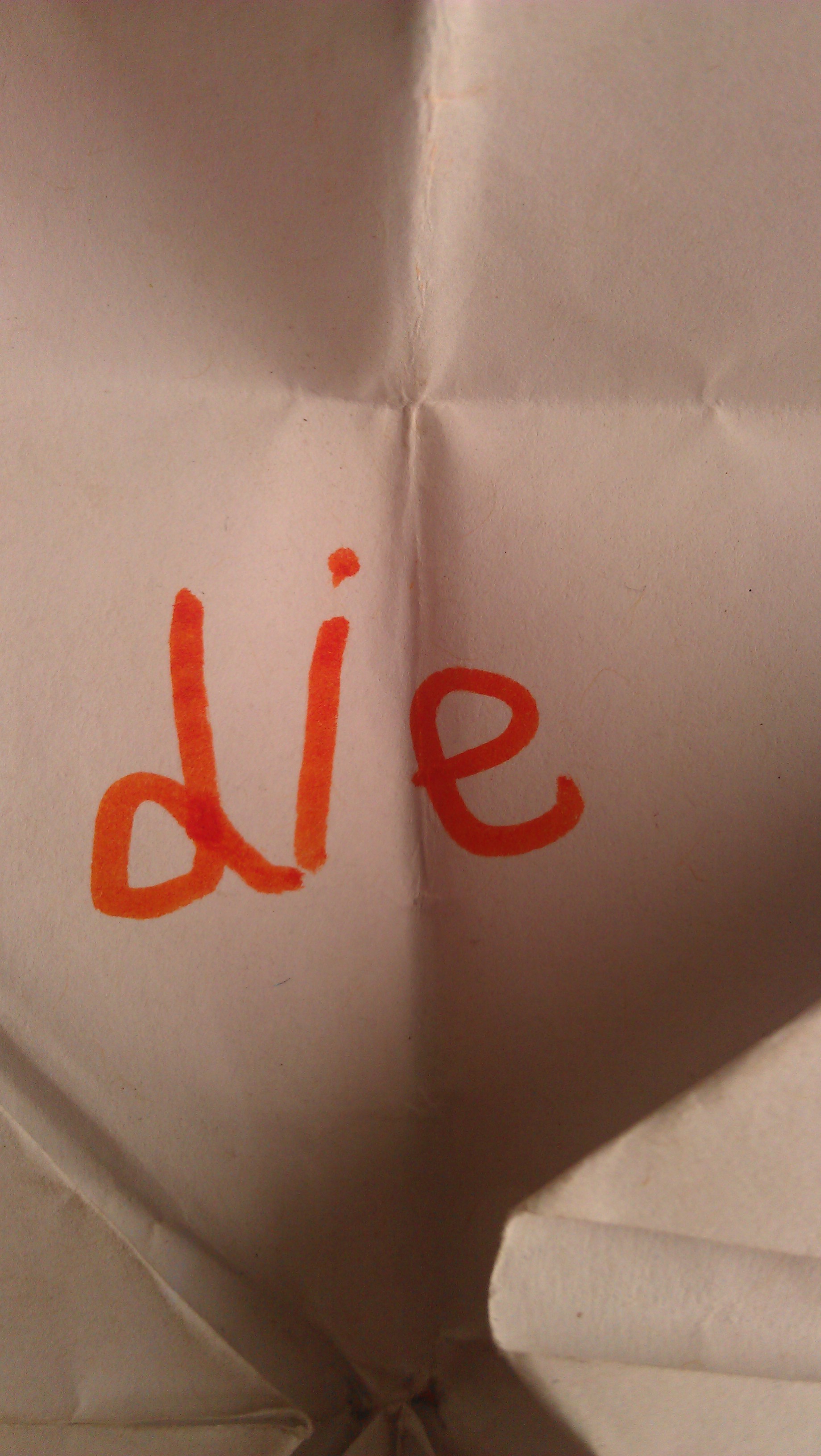
Whoa, whoa, whoa. Hold the phone. Never in all my elementary school years did I have that for a fortune. It was usually about kissing someone or marrying someone or wearing a certain outfit.

I looked askance at the camp counselors.

“I got die. That’s not how I remember these things.”

One of them smirked. “Yeah, I got die earlier today, too.”

I frowned a bit. “It it a command? A suggestion?”

His favorite counselor shrugged. “An inevitability?”

“Yes, well…”

The proud young man had his brother choose. Number, color, color…

IMAG3751

“Get a cougar? He gets a cougar? I die and he gets a cougar?! Life is so unfair.”

Peanut is simply beaming. He’s thrilled that the family finally has a cougar. Butter begs him for another try.

He chose a different number. And a different color.

Same result.

Dude gets two cougars. And I’m still dying.

This is some bullsh*t, y’all.

So I ask Peanut to make me a fortune-teller when we get home. He says he doesn’t know how. Never mind. I have made hundreds in my lifetime. Give me that thing and I’ll deconstruct it.

No problem. We grab a stack of paper and go in the yard. I have three fortune-tellers done before the kids have even remembered to ask for a snack.

Peanut makes this follow-up:

IMAG3742IMAG3743IMAG3744

IMAG3745IMAG3746IMAG3747

Pretty weak, if you ask me. Win a medal? Pbbbththth. Forty-four pieces of gold? Meh. Drink pee? Geez, boys are gross.

Butterbean suggested the following. All are verbatim answers to the following questions: “What numbers do you want me to write; what choices do you want me to write; and what do they get if they choose that answer?”

IMAG3756IMAG3758IMAG3757


IMAG3760 IMAG3761 IMAG3762 IMAG3763

Note that he always chooses B.O.G., which is frosting. B.O.C., B.O.P., and B.O.B. are less popular. With everyone.

Now I make a proper device of happiness and goodness.

IMAG3735

IMAG3736

That’s right…choose between apple pie and strawberry shortcake. I dare you. (I count out only the letters for the fruit, not the whole dessert. I’m old and don’t need fortune-teller arthritis.)

IMAG3737

Oh, yeah. Peach cobbler or blueberry pie. Colors my butt. things are gettin’ REAL up in here.

So Peanut picks a number. And a pie. And a blueberry tart.

IMAG3739

You got it, reader. I populated the whole thing with delightful ways to make mom feel good.

When he heard his fortune, the seven-year-old who often rolls his eyes and runs when I ask for affection actually shrugged, walked over, and gave me one heckuva hug.

You have to make your own fortune, people. That’s all I’m saying.


Beginner mind…fail

Perfectionists don’t deal well with failure.

Seems obvious enough, right?

While some people savor the lessons learned through mistakes, I begrudgingly accept my lesson and fume, often for years, over the failure.

I harbor residual embarrassment that I misspelled Connecticut in eight grade and am still painfully aware of exactly where I sat when I corrected the teacher for adding an unnecessary “c”. (I was also totally right. There’s no need to Connect anything in that name. It’s Conneticut. Or it ought be Conneticut.)

Mindful always of the failure implicit in mistakes, I stoke the fires of mortification at misunderstanding an attorney colleague in 1993. I had to make a joke at my own expense to hide my shame at the company softball game and I can still see the rolling fog and the skyward reach of the home-plate fence when I mistook “tort” for “tart.” And I still remember the warm wash of relief that flooded me on the third row of metal bleachers when They—the smarter, better educated, older, wiser—laughed at my cover joke. Thank goodness for the wounded-pride salve of comedy.

And thank goodness that I’m still self-flagellating over spelling and jargon errors from the 80s and 90s. Consider the world saved, y’all, because I know how dumb I was twice as a teenager.

Many of my struggles with parenting come from knowing I can do better, of knowing what kind of mother I aspire to yet failing to get there. I don’t believe I should ever yell. I should calmly explain expectations and requests and never inflict the psychological damage of raising my voice in anger. Each time one of the boys is hurting the other and I react with the panic of a raised voice, I judge myself harshly. How can you teach kindness with anger? How can you teach calm, measured responses if you don’t model them?

And how effective are cage matches as a parenting technique?

For the daily successes and failures in all that I do, I force a bedtime shrug and recall a mantra that insists, “I honestly did the best I could, I’ve thought about what could be better, and I will try my best again tomorrow with this new knowledge.” That hope and promise applies to writing and parenting and cooking and running and marriage and friendship. Though zen is a state of mind 180-degrees from my normal state of being, I do actually believe that approaching everything with beginning mind opens up possibilities for acceptable, awareness, and joy.

Of course, it’s a ruse, because I prefer to stick with what I’m really good at: cultivating a festering depression born of the self-suggestion that I make the same mistakes every day.  Since mediocrity is unacceptable, I roil in my shame and promise to work harder, work smarter, do better. Mostly as an exercise in roiling in shame, not because I actually plan to work harder, smarter, or better.

As I mentioned, totally un-Zen. Thank goodness I was born in a Western culture that digs perfectionism a tiny bit more than mindfulness.

Because my biggest failure lately is physical. Last night I left my beloved fencing academy knowing that I suck at fencing.

Oh, I have myriad excuses. When poor Spouse is foolish enough to get caught in a room with me after fencing, he hears about how few years, really, I’ve been practicing. Two years in college, a frightful amount of which was spend drilling not fencing. Perhaps three hundred hours of drills and three hundred hours of competition. Twenty years off for life, work, school, children. One full year back in earnest, practicing, training, and actively seeking bouts an average of once a week. One hundred hours of trying to stab and not be stabbed, perhaps, since I’ve been back.

Rank beginner by the numbers, I insist. Excusable levels of failure for one as new as I am, I pretend to believe. Four hundred hours of fencing really isn’t much.

Yes, I know how stupid that seems. Four hundred hours of anything and I should totally be an Olympian, right? What a loser.

“But, but, but,” I sputter, “practice begins at 7pm. Ends at 10pm. I’m exhausted all hours of the day, but being expected to have quick reaction times and good form at 10pm is ludicrous. It’s not possible. It’s everyone’s fault but mine!”

Often I spend most of the ride home plying myself with perspective, mostly to fend of the inevitable self-medication-by-desserts. “Buck up, self. You’ve been working as hard as you can, and you’ve shown marked improvement.” (That much is actually true. Some weeks I have a flashes of skill at this game that is often described as athletic chess. Teammates have watched and have cheered my successes, have noted to me that they see how quickly I’m improving. Shhhh. Don’t tell the perfectionist in the corner whose withering glare is making me eat another brownie.)

Sufficient progress eludes me. It’s not quick enough. I don’t want to be perfect…I want to be as good as I think I should be. Reasonable expectations, yo. The weeks where I surge precede, obviously and predictably, lengthy plateaus. Weeks, or recently months, of feeling as though I am not progressing. Not doing well enough. Not trying hard enough. Too slow and stupid and old for this sport.

A long, mournful ride home last night followed five bouts, each lost 5-0. For those keeping score at home, that’s 25-0. Pathetic beyond pathetic. It’s a new low. In 22 years of fencing I’ve never been this bad.

(Quick note from my pride: I did score several touches, but not when we were keeping score. We usually fence for ten to fifteen minutes before we finally say, “okay, let’s go to five.” Usually means one of us feels tired or thirsty or bored of the other fencer.)

(Do you like how, in a post about how I can’t bear knowing I’m bad at something, I have to adjust an admission of being terrible with a caveat that I’m not that terrible? Perfectionism is a disease, people. Inoculate your children now, if your physician allows it.)

So, with clarity of mind and resonant self-awareness born of a dreadful night of fencing failure, I decided I need a new sport.

The other fencers laughed, and we talked about how I would most likely approach baseball, hockey, tennis, and croquet by standing about lunge-distance from my opponent and trying to hit her with the bat, stick, racquet, or mallet.

Ha ha, we chuckled.

And I died a little inside.

Because we all knew I’d be bad at those sports, too.

I felt sorry for myself for being unathletic. Whimpered in the car about being terrible at every sport I’ve ever tried. Wallowed in the reality that I was a slow triathlete and a miserable fencer and a mediocre tennis player.

And after the self-pity waned, I knew that, as with all failure, I have two options. Learn. Or Quit.


attack out of distance

feint out of distance isn’t fooling anybody
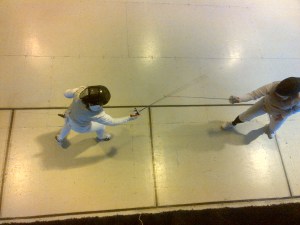
searching for the blade begging for attack into preparation

searching for the blade is begging for attack into preparation
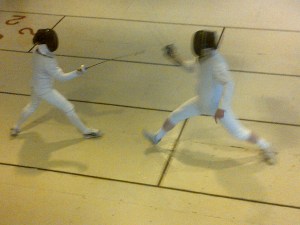
better parry that or you're gonna lose another touch

 stop counterattacking and parry, for heaven’s sake!


I can work harder and smarter. I can make running and weight training a priority, incorporating plyometrics to get some of the speed and agility lost with age; I can pay for lessons; I can take better notes to process what is and isn’t working each week before and after class. I can better plan my weekly goal, which I generally formulate on the drive to the studio, and focus on it more clearly during the evening. I can add simple carbohydrates to the evening, strategically applying calories to the work of getting better.

Or I can quit.

For a perfectionist, there really aren’t many other choices. Just showing up as often as I can and pushing as hard as I can is not acceptable. There must be Lifetime-television-celebrated moments of triumph at least every half hour or so.

Achievement isn’t called do-your-best-ment. I either have to step up my game, or I have to give up.

Now. If you’ll excuse me, I have to go speak quietly and respectfully to my kids.